Medically Reviewed by Dr. Christen Simpson Raynes on September 29, 2026

The right implant approach depends on how many teeth you are missing and what your smile goals look like. A single tooth implant replaces one lost tooth with a standalone titanium post and crown. In contrast, a full-arch restoration replaces an entire upper or lower row of teeth, using multiple implants to anchor a fixed, permanent prosthesis. Both are proven, long-lasting solutions. The key is knowing which one fits your situation.
At Simpson Dental, Dr. Christen Simpson Raynes and Dr. Chase Preston help patients navigate this decision every day. Whether you are dealing with one missing tooth or have been living with significant tooth loss for years, our team has the training and technology to guide you toward a result you will be proud of for decades to come.
What a Single Tooth Implant Involves
A single tooth implant is often the most straightforward implant option available, and it is an excellent fit for patients who have lost one tooth due to injury, decay, or extraction. The process involves placing a titanium post into the jawbone, allowing it to fuse with the bone over a healing period, and then attaching a custom crown on top.
Why Single Implants Work So Well
Single implants stand out because they function entirely independently. They do not rely on neighboring teeth for support the way a bridge does, which means healthy adjacent teeth remain untouched. Research published in the National Institutes of Health found that both immediately placed and delayed single implants achieved survival rates of 98.4% to 98.6%, confirming that this approach delivers highly predictable outcomes. Single implants also preserve jawbone density at the site of the missing tooth, which helps maintain the shape of your face over time.
The Single Implant Process
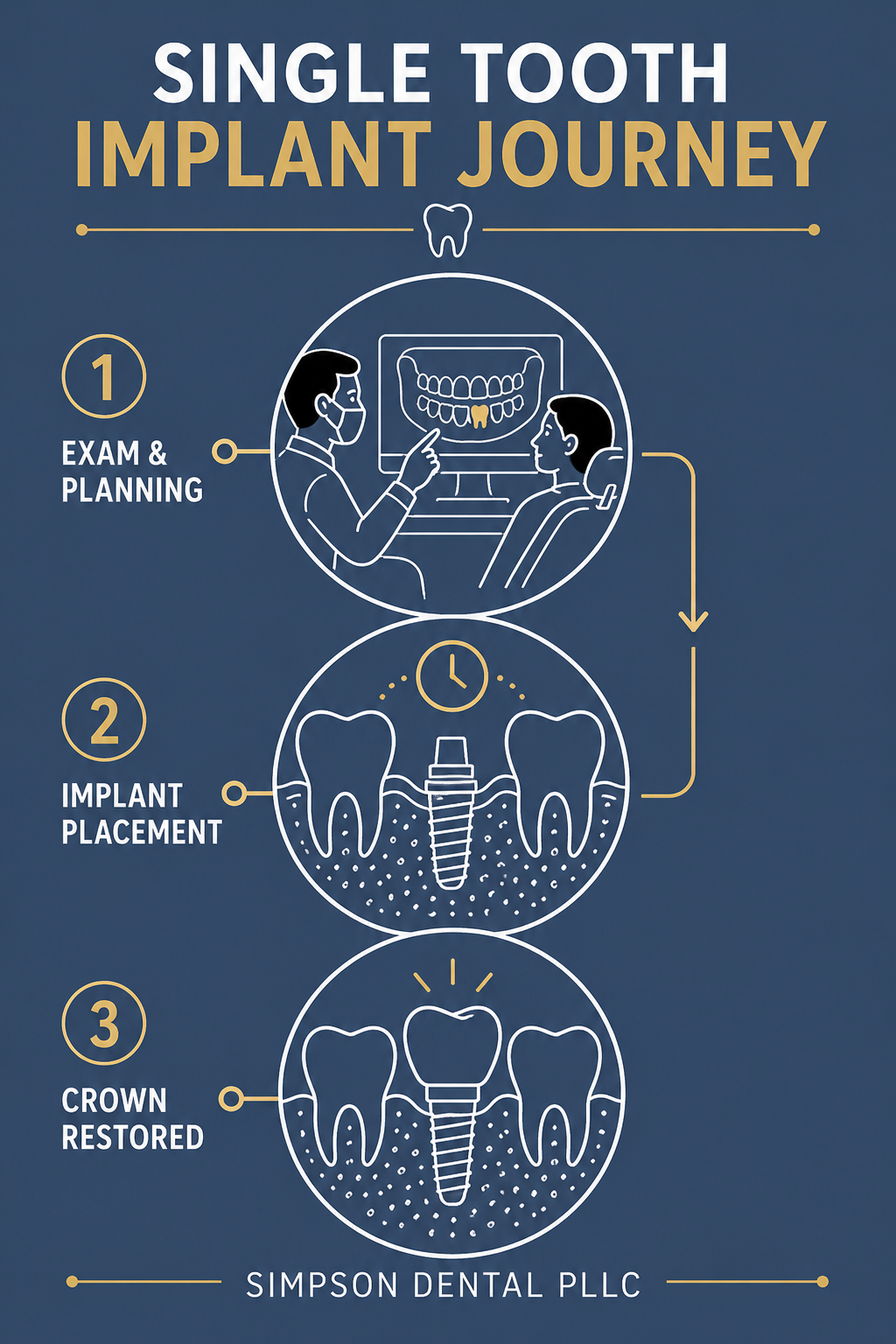
The timeline for a single-tooth implant typically spans several months, though same-day options may be available depending on your individual circumstances. Here is a general outline of the steps involved:
- A consultation and imaging session to assess bone density and plan placement
- Surgical placement of the implant post, followed by a healing period for osseointegration
- Placement of the permanent crown once the implant has fully integrated
Each step is handled with precision at our in-office dental lab, where our three full-time technicians, who bring a combined 60 years of experience, craft restorations that match your natural teeth in both shape and color.
What Full Arch Restoration Involves
Full arch restoration is designed for patients who are missing all or most of the teeth on an upper or lower arch. Rather than placing an implant for every individual tooth, this approach uses a series of strategically positioned implants to support a fixed full arch of teeth. The result looks, feels, and functions like natural teeth, and it is permanently anchored in place.
Full-mouth restorations are often life-changing for patients who have been struggling with removable dentures or extensive tooth loss. Unlike traditional dentures, a full arch restoration does not slip, shift, or require adhesive. Because the implants fuse directly to the jawbone, patients regain strong biting force and the confidence to eat, speak, and smile without hesitation.
The primary difference between a full arch case and a single implant case is scope. A full arch treatment requires a more comprehensive plan, a greater number of implants, and a longer overall process. The prosthesis itself is a fixed, custom-crafted arch rather than a single crown. For patients exploring implant-supported denture options, a full-arch restoration is the most permanent and functional choice. In some cases, a teeth-in-a-day approach may allow patients to leave with a temporary restoration on the same day as implant placement.
How to Know Which Option Is Right for You
Choosing between a single implant and a full arch restoration comes down to a thorough evaluation of your oral health, the number of missing teeth, and your goals. Neither option is one-size-fits-all, and the right path forward is one that accounts for your full clinical picture.
A few questions to consider as you prepare for your consultation include how many teeth you currently have missing, whether you are experiencing jawbone loss, and how much your tooth loss affects your daily life. Patients who have lost a single tooth in an otherwise healthy mouth are typically excellent candidates for a single implant. Patients with more widespread tooth loss, particularly those already wearing removable dentures, often benefit most from a full-arch approach.
The dental implant FAQs page is a helpful starting point for anyone with questions about candidacy, timing, or what to expect from the process. Ultimately, a conversation with our team is the clearest path to an answer.
Find Your Best Option at Simpson Dental PLLC
At Simpson Dental PLLC, our approach to implant care is built on a family legacy and a genuine commitment to long-term results. Dr. Christen Simpson Raynes and Dr. Chase Preston bring a thorough, patient-centered approach to every implant consultation, taking the time to understand your goals and to recommend a treatment plan tailored to your specific needs. Our on-site dental lab means your restorations are crafted in-house by skilled technicians, giving us greater control over quality, fit, and aesthetics at every stage of treatment.
Whether you are exploring a single-tooth replacement or considering a full-arch transformation, we are here to walk you through every step. We work with most major insurance providers and offer flexible financing options to make implant care accessible. Schedule your consultation today and take the first step toward a smile that lasts.
How long do dental implants last?
With proper care, dental implants can last a lifetime. The titanium post that fuses with the jawbone is designed for permanent placement. The crown or prosthesis attached to the implant may need to be replaced after 10 to 15 years depending on wear, but the implant itself typically remains stable indefinitely. Consistent oral hygiene and regular dental checkups are the most important factors in implant longevity.
How do I know if I am a candidate for a dental implant?
Good candidates for dental implants generally have adequate jawbone density to support the implant, healthy gum tissue, and no uncontrolled systemic conditions that could interfere with healing. Patients who have experienced significant bone loss may still be candidates after a bone grafting procedure. The best way to determine candidacy is through a comprehensive evaluation, including imaging, at Simpson Dental.
Is the dental implant procedure painful?
The implant placement procedure is performed with local anesthesia, so most patients feel little to no discomfort during the procedure itself. Some soreness and mild swelling are normal in the days following placement and are typically manageable with over-the-counter pain medication. Most patients find the recovery more comfortable than they expected going in.
How does a full arch restoration compare in cost to traditional dentures?
Full arch implant restorations typically involve a higher upfront investment than traditional removable dentures. However, they are also more durable, more functional, and require no adhesives or replacement over the years the way removable dentures do. Many patients find that the long-term value and quality of life improvement make the investment worthwhile. Simpson Dental offers flexible financing options to help make implant care accessible.
ABOUT THE AUTHOR
Dr. Christen Simpson Raynes
Dentist, Simpson Dental PLLC — Charleston, WV
Dr. Christen Simpson Raynes is a third-generation dentist at Simpson Dental PLLC in Charleston, West Virginia, continuing a family legacy of dental care that began in 1948. She focuses on full arch implant restoration and complex restorative cases, holds memberships with the Academy of Osseointegration and the American Academy of Implant Dentistry, and has helped restore more than 6,000 implants for patients across the Charleston region.